YOU SHALL NOT PASS: SC Upholds Labor Rights Against Dismissal by Prevention from Work
The typical Filipino worker reports for duty every day, relying on that daily effort to feed their family. Imagine showing up at the factory gate or office lobby, ready to start your shift, only for the security guard to tell you, "Sir/Ma'am, you are no longer allowed to enter." For the average manggagawa, this is not only a frustrating delay, but a sudden and devastating end to their livelihood.
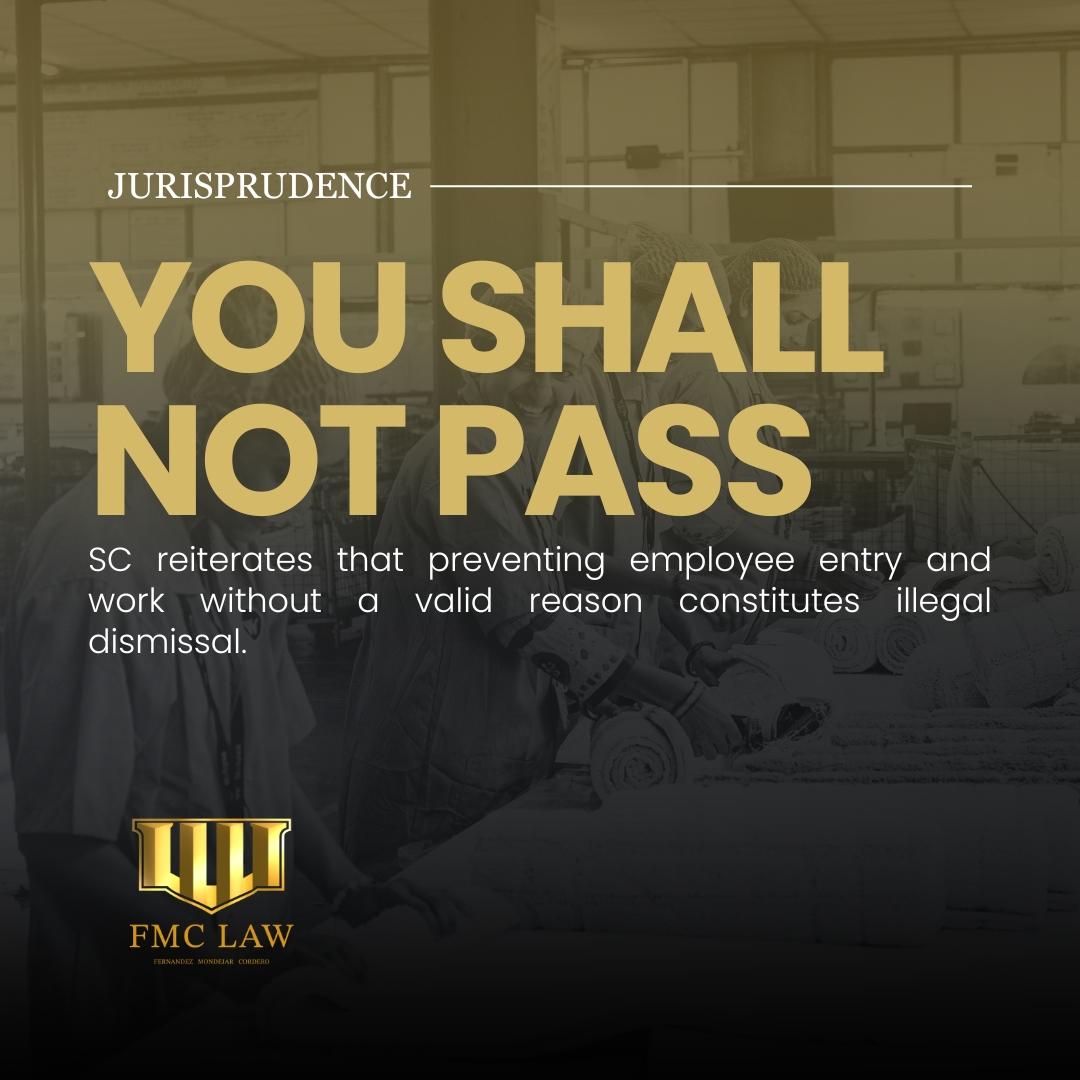
When a company bars an employee from their post, is that considered a formal dismissal? Many employers in the Philippines attempt to use this subtle tactic to avoid the legal burdens and procedural requirements of a formal termination. They use the defense that since no written notice was issued, no dismissal occurred. However, the Supreme Court recently reaffirmed a fundamental principle in labor law: preventing an employee from working without due process is, in itself, an act of illegal dismissal. This ruling serves as an important affirmation of workers' rights, even for those whose pay is based on output.
What Keeps the Doors Open
To fully grasp the significance of the SC's decision, one must first understand the employment structure involved and the fundamental rights of a worker under Philippine labor laws.
The Pakyaw System in Philippine Labor Law
The term pakyaw (or "piece-rate") work means that employees are paid based on the output they produce, rather than the amount of time they spend working. This system is common in manufacturing, construction, and packing industries.
The crucial distinction established in cases like A. Nate Casket Maker vs. Elias V. Arango is that pakyaw workers are still generally considered regular employees entitled to the same basic labor rights as any other employee. This includes security of tenure, holiday pay, and service incentive leave pay. The only typical exception is that they are usually not entitled to 13th-month pay if they fall under the legal exception for those paid purely on a commission or task basis without a fixed salary. This right to security of tenure means they cannot be fired arbitrarily.
Illegal Dismissal and Due Process: The Twin-Notice Rule
The fundamental principle violated when an employee is barred from entry is the right to due process and security of tenure. The Supreme Court ruling confirms that any act by the employer that makes the continuation of employment impossible, such as denying the employee access to the workplace, is an act of dismissal.
For a termination to be valid under the Labor Code of the Philippines, the employer must adhere to the Twin-Notice Rule:
First Written Notice: A notice of intent to dismiss, clearly stating the ground for termination and giving the employee a reasonable opportunity to explain their side.
Second Written Notice: A notice of decision informing the employee of the verdict after a fair hearing.
The failure to follow this two-notice procedure, even if a valid cause for dismissal exists, is a violation of the employee's due process rights, rendering the dismissal unlawful. The principle reaffirmed by the SC is straightforward: an employee who is ready, willing, and able to work, but is prevented from doing so without a valid cause, is considered illegally dismissed—a concept often referred to as "dismissal by preclusion from work."
Barred from the Gate
In the recent decision written by Senior Associate Justice Marvic M.V.F. Leonen, the Supreme Court’s Second Division upheld the rulings of the labor arbiters in favor of 12 workers who were employed by Constant Packaging Corporation as sorters and packers on a pakyaw basis.
The issues began when the workers raised legitimate concerns about poor working conditions: they were earning below-minimum wages, working 12-hour days, 7 days a week, and the company was failing to remit their mandatory SSS, PhilHealth, and PAG-IBIG contributions. They also experienced delayed salaries. Constant Packaging responded to their complaints by essentially telling them to leave if they were unhappy.
The workers then lodged a formal complaint with the Department of Labor and Employment (DOLE). Soon after, the company retaliated. The company security guard blocked the workers from entering the company premises. This action prompted the workers to file a complaint for illegal dismissal.
The Supreme Court ruled clearly that the company's act of instructing the security guard to block the workers' entry was a clear act of dismissal. Since the workers were ready and willing to work, the company's refusal to accept their services was an unlawful termination of their employment.
The dismissal was declared illegal on two counts. First, there is no valid cause. The termination was not based on any just or authorized cause recognized by the Labor Code. It was a retaliatory move against workers exercising their rights. Second, there is no due process: The company failed to observe the mandatory Twin-Notice Rule. The workers were simply barred from the gate without any written notice of intent to dismiss or a chance to explain their side.
The SC thus ordered Constant Packaging to pay the workers separation pay (in lieu of reinstatement), back wages, service incentive leave, and holiday pay. Consistent with the legal framework for pakyaw workers, the only claim the Court denied was the 13th-month pay, which does not typically apply to this pay arrangement.
Beyond the Exit Walls
The Supreme Court's ruling sends a strong message to employers across the country that security of tenure and the right to due process are important in Philippine labor law. Employers cannot use subtle tactics, like barring entry, to circumvent the obligations of a proper dismissal. If a worker is ready and able to work, the denial of access to the workplace is considered a full termination of the employer-employee relationship and must be justified by valid cause and due process. This ruling ensures that even pakyaw workers, who are often seen as less protected, are secured against arbitrary termination.
To ensure strict compliance with the Labor Code, both employers and employees should seek legal counsel. If you are an employer in big cities, a law office in Manila or an Iloilo-based law firm can help you establish proper employment termination procedures. If you are an employee facing unlawful termination, seeking legal consultation or hiring a litigation firm with experienced lawyers is the first step. Finding a trusted litigation attorney in NCR or regions like Western Visayas near you can help you assert your rights and recover what is due to you.