Untying the Knot: A Guide to Annulment, Nullity, and Legal Separation
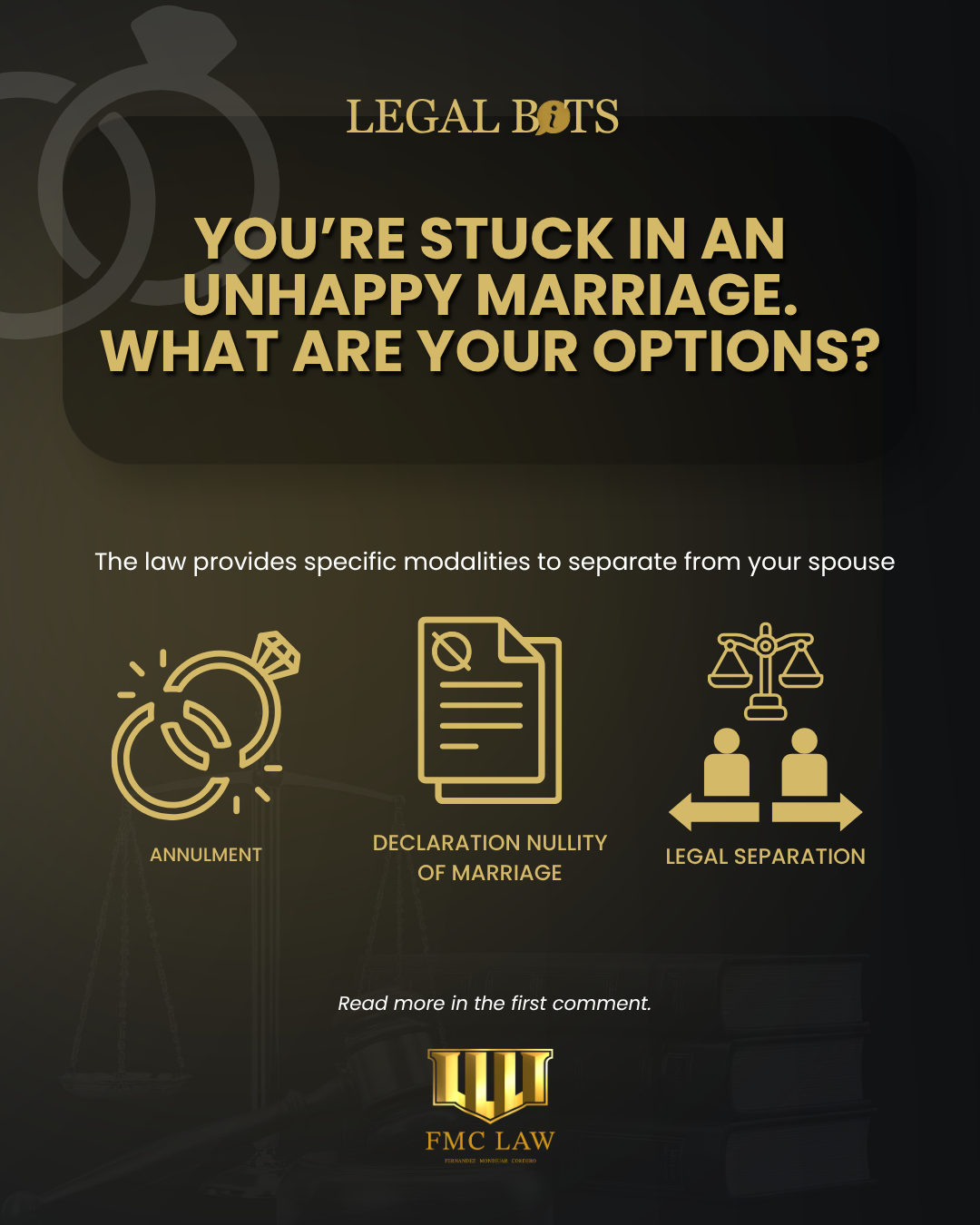
Navigating the end of a marriage is one of the most emotionally taxing experiences a person can go through. Beyond the heartache, there is a mountain of legal questions: Can I get a divorce? Is my marriage even valid? Can we live apart without being 'divorced'?
In the Philippines, the legal landscape is unique. Because "absolute divorce" is not yet a law for the general public, many people find themselves confused by terms like "Annulment," "Declaration of Nullity," and "Legal Separation."
To help you navigate this, let’s break down the three primary legal options available under Philippine law.
Annulment
An "annulment" applies to "voidable" marriages. These marriages are considered valid and binding until they are set aside by a court.
You may qualify for an Annulment if:
Lack of Parental Consent (Art. 45[1]): If a party was between 18 and 21 and married without parental consent. The petition must be filed within five years of reaching age 21.
Insanity or Unsound Mind (Art. 45[2]): If either party was mentally ill or incapacitated such that they could not understand the nature of marriage.
Fraud (Art. 45[3], Art. 46): This includes the concealment of a prior criminal conviction, pregnancy by another man, a sexually transmissible disease (STD), or drug addiction.
Force, Intimidation, or Undue Influence (Art. 45[4]): If consent was obtained through duress. Continued cohabitation after the force ceases bars the annulment.
Impotence or Physical Incapacity (Art. 45[5]): An incurable inability to consummate the marriage that was unknown to the other party.
Serious and Incurable STD (Art. 45[6]): If a party had a serious, incurable STD existing at the start of the marriage.
Note: Many annulment grounds have a "deadline." Usually, you must file within five years of the wedding or of discovering the problem.
Declaration of Nullity
This is for marriages that the law considers "void from the beginning." You aren't breaking a bond; you are asking the court to recognize that the marriage never actually happened.
Common Grounds for Nullity:
Minority (Art. 4, Art. 35): Either party was below 18 years old at the time of the wedding, even with parental consent
Bigamy or Polygamous Marriages (Art. 35, Art. 41): One person was already legally married to someone else.
Incestuous Marriages (Art. 37, Art. 38): Marriages between close blood relatives (ascendants/descendants and siblings)
Psychological Incapacity (Art. 36): A spouse cannot fulfill essential marital duties like love, respect, and support. Under recent Supreme Court rulings, this is a legal—not medical—condition and is easier to prove than before.
Solemnized by an Unauthorized Officer (Art. 35, Par. 2): A marriage is void if it was performed by someone who did not have the legal authority to perform marriages, unless either or both of the parties believed in good faith that the officer had the authority.
Legal Separation
Unlike annulment or nullity, legal separation does not end the marriage. You remain husband and wife in the eyes of the law. What changes is that you are allowed to live apart, and your property regime is dissolved and liquidated. You may file for Legal Separation under Articles 55 to 67 of the Family Code if your spouse commits any of the following:
Repeated physical violence or grossly abusive conduct directed against you or your children
Sexual infidelity or perversion
Attempt by the spouse against your life
Drug addiction, habitual alcoholism, or homosexuality
Abandonment of the marital home without justifiable cause for at least one year
Imprisonment of the spouse for more than six years
At a Glance
Feature | Declaration of Nullity | Annulment | Legal Separation |
Status of Marriage | Void from the beginning | Valid until annulled | Remains valid |
Can you remarry? | YES | YES | NO |
Primary Cause | Lack of legal essentials (e.g., Bigamy, Incest). | Defects at the time of wedding (e.g., Fraud, Lack of Consent). | Misconduct during marriage (e.g., Abandonment, Infidelity). |
Property Status | Dissolved/Distributed | Dissolved/Distributed | Separately managed |
The First Step to Your New Life
Ending a marriage is a technical process. Filing the wrong petition can waste years of time and money. If you are ready to resolve your marital status, the first step is a clear consultation to see which part of the law fits your story.
Whether you are looking for a litigation lawyer in Iloilo or an Attorney in Manila, professional legal advice is the only way to ensure your petition is filed correctly.
Speak with a lawyer today to find out which path leads to your fresh start.