The “Due” is Undue: SC Nullifies Foreclosures Over Unfair Bank Interest Rates
A family sits around their kitchen table, a bank letter lying between them. Outside, the world is moving, but inside, time has stopped. This letter, thin and crisp, carries the weight of a mortgage they have paid for years, but now the notice of foreclosure looms. The dream of their own property, the very roof over their heads, is dissolving over a disputed number: the interest rate.
For countless Filipinos, the path to homeownership hinges on securing a bank loan. Unfortunately, this financial commitment comes tethered to the constant threat of foreclosure. Recent reports underscore this reality. For instance, news of thousands of foreclosed units being put up for auction by major government housing institutions reminds us that missed payments quickly lead to a loss of property. When foreclosure proceedings begin, the borrower's total debt and, most importantly, the interest charged become the focus of intense legal scrutiny. This is exactly where the law steps in, ensuring the scales of justice remain balanced against unilateral bank power.
Law’s Demand for Just Agreement
The core principle that safeguards every borrower is the Mutuality of Contracts, a foundational rule under the Civil Code of the Philippines. This principle ensures that a contract is a two-way street, preventing one party from holding all the power. Article 1308 of the Civil Code explicitly states: "The contract must bind both contracting parties; its validity or compliance cannot be left to the will of one of them." This rule exists precisely to prevent one party, especially a dominant entity like a bank, from unilaterally changing the terms of the agreement after it has been signed.
The Power of Obligation: Article 1159 solidifies this, stating that obligations arising from contracts "have the force of law between the contracting parties." This means both you and the bank are strictly bound by what you agree to.
The Limit to Freedom: While Article 1306 grants wide freedom in drafting contracts (autonomy), this freedom is severely limited if the terms go against established law, morals, good customs, or public policy. The bank's autonomy stops where the borrower's rights begin.
Why Unilateral Increases are Void
In established Philippine doctrine, any clause that grants one party (the bank) the sole power to revise the interest rate or any essential obligation without the borrower’s explicit and timely consent is, from the start, void. Banks may link floating interest rates to an objective, verifiable external index (like a specific central bank rate). However, allowing a lender sole, secret discretion based on vague terms like "market conditions" directly violates the mutuality principle. This unilateral power strips the borrower of the ability to foresee and prepare for their debt obligation, turning the agreement into a trap.
The Voided Seizure
The recent Resolution from the Supreme Court (SC), penned by Associate Justice Ricardo R. Rosario of the SC’s Special Third Division, has provided the definitive clarification on this issue which will empower borrowers against constraining lenders.
The dispute centered on Ang and Fernandez, who had obtained a substantial PHP 16-million loan from United Coconut Planters Bank (UCPB). The critical clause in their documents permitted UCPB to unilaterally adjust the interest rate every quarter based entirely on its own subjective view of market conditions. When Ang and Fernandez eventually defaulted on their repayment schedule, UCPB immediately initiated the extrajudicial foreclosure of their assets.
Ang and Fernandez challenged the foreclosure sale in the Regional Trial Court (RTC). They argued that the bank's self-granted power to set and increase the interest rate meant the final computed rate was unfair and, more importantly, legally invalid.
Initially, the High Court agreed that the interest rate clause was invalid but controversially upheld the foreclosure, reasoning that the borrowers were still technically in default on the principal. However, the borrowers filed a Motion for Reconsideration, pushing the Court to re-examine the true implication of an illegal interest rate.
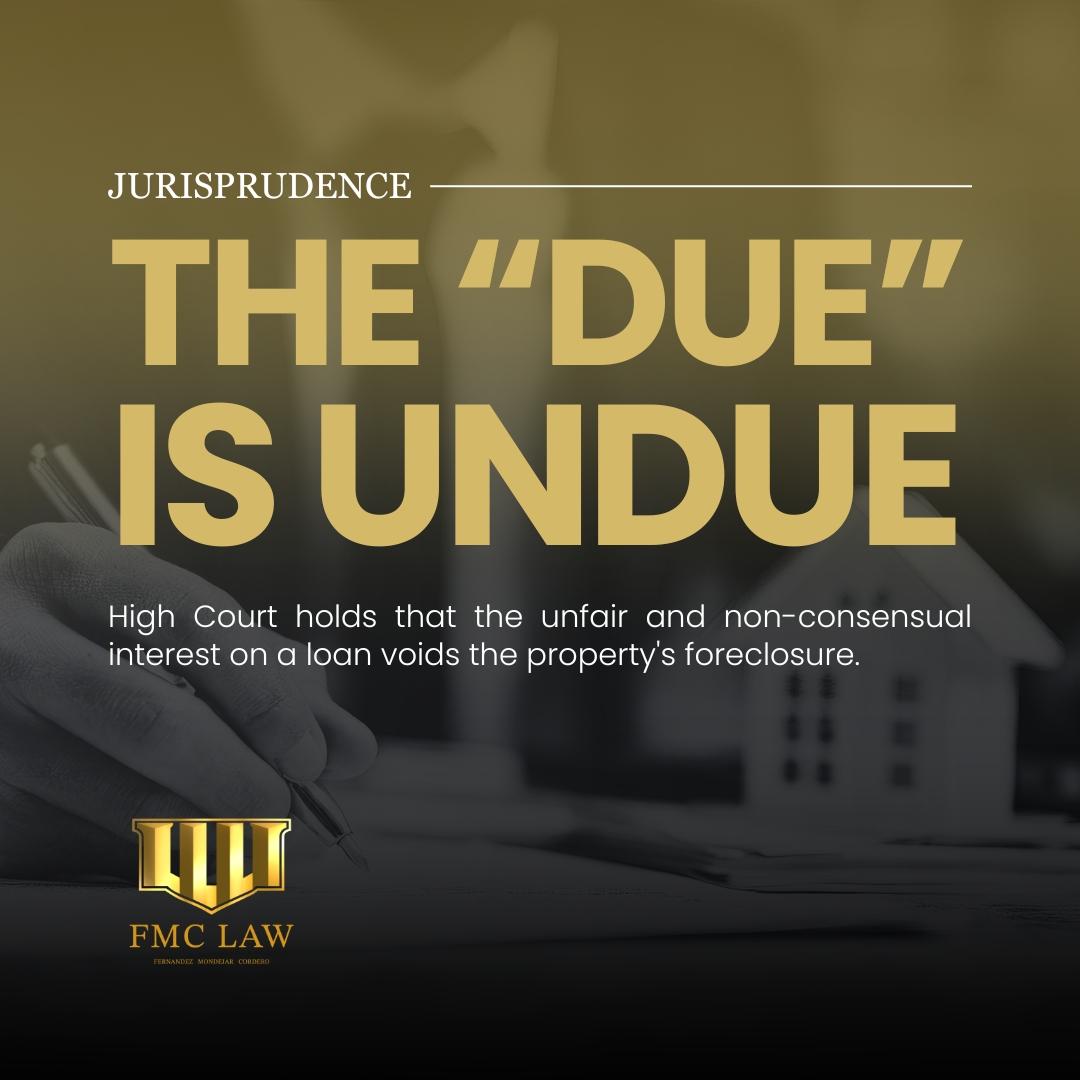
The SC ruled that if the interest charged on the unpaid loan was unconscionable or imposed unilaterally by the lender without mutual consent, then any foreclosure that subsequently follows is also nullified and void.
The Court underscored that contracts must be fair and mutually agreed upon. The SC unequivocally held that since UCPB had retained sole authority to determine the interest rate, that rate violated the mutuality of contracts. Since the inflated interest rate used to calculate the debt was invalid, the total debt amount was wrong. Consequently, the borrowers could not be declared in default of the correct, uninflated debt. Without a valid default, the foreclosure was premature and void.
Justice Rosario wrote that the borrowers must be granted a fair opportunity to settle their loan based on an interest rate mutually agreed upon by both parties. Otherwise, they would face the devastating risk of losing their property without a fair chance to settle their actual, legal obligation.
Your Principal Defense
The Supreme Court has firmly asserted that the law demands a just weight and balance in all contractual dealings. What one party may view as an extreme right (unilateral power) can be swiftly ruled an extreme wrong. Banks and other lenders are now squarely on notice as they cannot use unilateral interest clauses as an enforcement mechanism for foreclosure.
If you are a borrower currently facing a foreclosure action, or if you suspect your loan documents contain a similar one-sided interest clause, you must take immediate action. Have your loan documents scrutinized for clauses that violate the principle of mutuality.
Protecting your property and your finances requires specialized legal knowledge.
Whether you are a borrower in Metro Manila facing a massive bank claim or a family in Western Visayas fighting to keep your home, your next step is to secure expert counsel. Consult a seasoned attorney in Manila or a reputable law firm in Iloilo City for immediate support. The battle is not over until the court says it is.