Starting Over: The Difference Between Void and Voidable
Staying in a marriage that no longer works is a heavy burden. In the Philippines, where divorce is not yet an option, many feel trapped when a relationship becomes unsustainable. However, the law provides specific ways to address your marital status and help you move forward.
Understanding your options starts with knowing the difference between Annulment and a Declaration of Nullity. While people often use these terms interchangeably, they are very different legal strategies. Choosing the right one depends on what happened before or at the moment you said "I do." Annulment
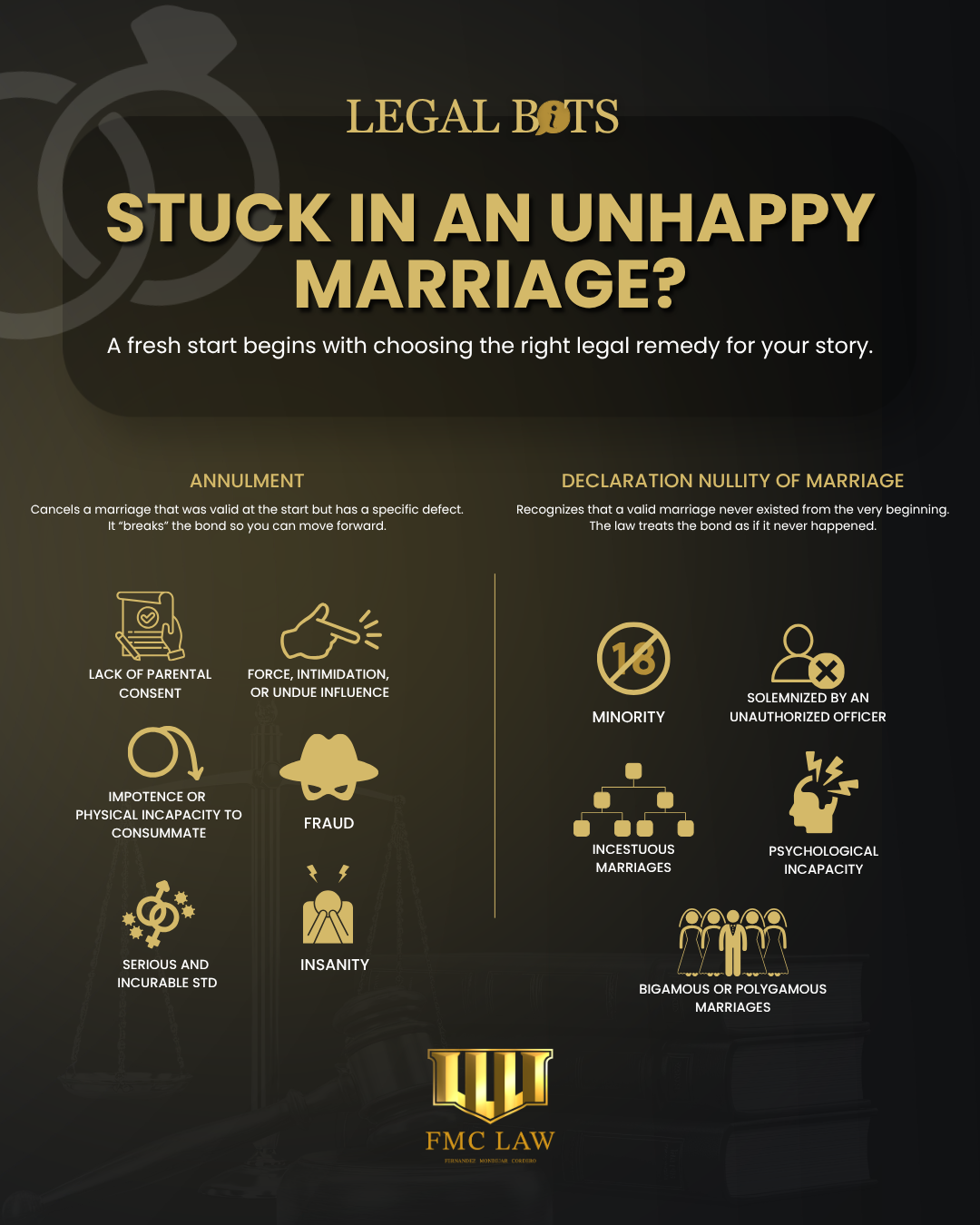
An annulment is for a marriage that is legally "valid" for now, but has a major flaw. You are asking the court to cancel the bond because of a specific problem that existed at the start.
You may qualify for an Annulment if:
Lack of Parental Consent (Art. 45[1]): If a party was between 18 and 21 and married without parental consent. The petition must be filed within five years of reaching age 21.
Insanity or Unsound Mind (Art. 45[2]): If either party was mentally ill or incapacitated such that they could not understand the nature of marriage.
Fraud (Art. 45[3], Art. 46): This includes the concealment of a prior criminal conviction, pregnancy by another man, a sexually transmissible disease (STD), or drug addiction.
Force, Intimidation, or Undue Influence (Art. 45[4]): If consent was obtained through duress. Continued cohabitation after the force ceases bars the annulment.
Impotence or Physical Incapacity (Art. 45[5]): An incurable inability to consummate the marriage that was unknown to the other party.
Serious and Incurable STD (Art. 45[6]): If a party had a serious, incurable STD existing at the start of the marriage.
Note: Many annulment grounds have a "deadline." Usually, you must file within five years of the wedding or of discovering the problem.
Declaration of Nullity
This is for marriages that the law considers "void from the beginning." You aren't breaking a bond; you are asking the court to recognize that a legal marriage never actually happened.
Common Grounds for Nullity:
Minority (Art. 4, Art. 35): Either party was below 18 years old at the time of the wedding, even with parental consent
Bigamy or Polygamous Marriages (Art. 35, Art. 41): One person was already legally married to someone else.
Incestuous Marriages (Art. 37, Art. 38): Marriages between close blood relatives (ascendants/descendants and siblings)
Psychological Incapacity (Art. 36): A spouse cannot fulfill essential marital duties like love, respect, and support. Under recent Supreme Court rulings, this is a legal—not medical—condition and is easier to prove than before.
Solemnized by an Unauthorized Officer (Art. 35, Par. 2): A marriage is void if it was performed by someone who did not have the legal authority to perform marriages, unless either or both of the parties believed in good faith that the officer had the authority.
Annulment vs. Nullity of Marriage: At a Glance
FEATURE | ANNULMENT | DECLARATION OF NULLITY |
Status | Valid until "canceled" | Never valid from day one |
Can it be fixed? | Yes, by staying together | No, it stays void |
Deadline | Usually within 5 years | None (File anytime) |
Children | Usually stay Legitimate | Generally Illegitimate* |
*Note: Children in "Psychological Incapacity" cases remain Legitimate.
Children and Property
The law protects children and ensures fair property division.
Children: Most children of these cases remain legitimate under the Family Code. Mothers usually get custody of children under seven, and both parents must provide financial support.
Property: In Nullity cases, property is usually split based on who contributed what. In Annulment cases, the "innocent" spouse may receive a more favorable share of the marital assets.
The First Step to Your New Life
Ending a marriage is a technical process. Filing the wrong petition can waste years of time and money. If you are ready to resolve your marital status, the first step is a clear consultation to see which part of the law fits your story.
Whether you are looking for a litigation lawyer in Iloilo or an Attorney in Manila, professional legal advice is the only way to ensure your petition is filed correctly.
Speak with a lawyer today to find out which path leads to your fresh start.