Breaking the Tie: What is the Difference Between Annulment and Declaration Nullity of Marriage?
Standing at the end of a marriage is often a lonely and confusing experience. For many, the realization that a relationship has become unsustainable is followed by a daunting list of legal questions. While most people use the term "Annulment" as a general catch-all for ending a marriage in the Philippines, the law actually provides two very different paths. Choosing between them depends entirely on the specific circumstances that existed at the time of the wedding.
Navigating these terms is not just a matter of vocabulary; it is a matter of legal strategy. A marriage that is "voidable" requires a different set of evidence and follows different timelines than a marriage that is "void from the beginning." Understanding these distinctions under the Family Code is the first step toward reclaiming your status and moving forward with your life.
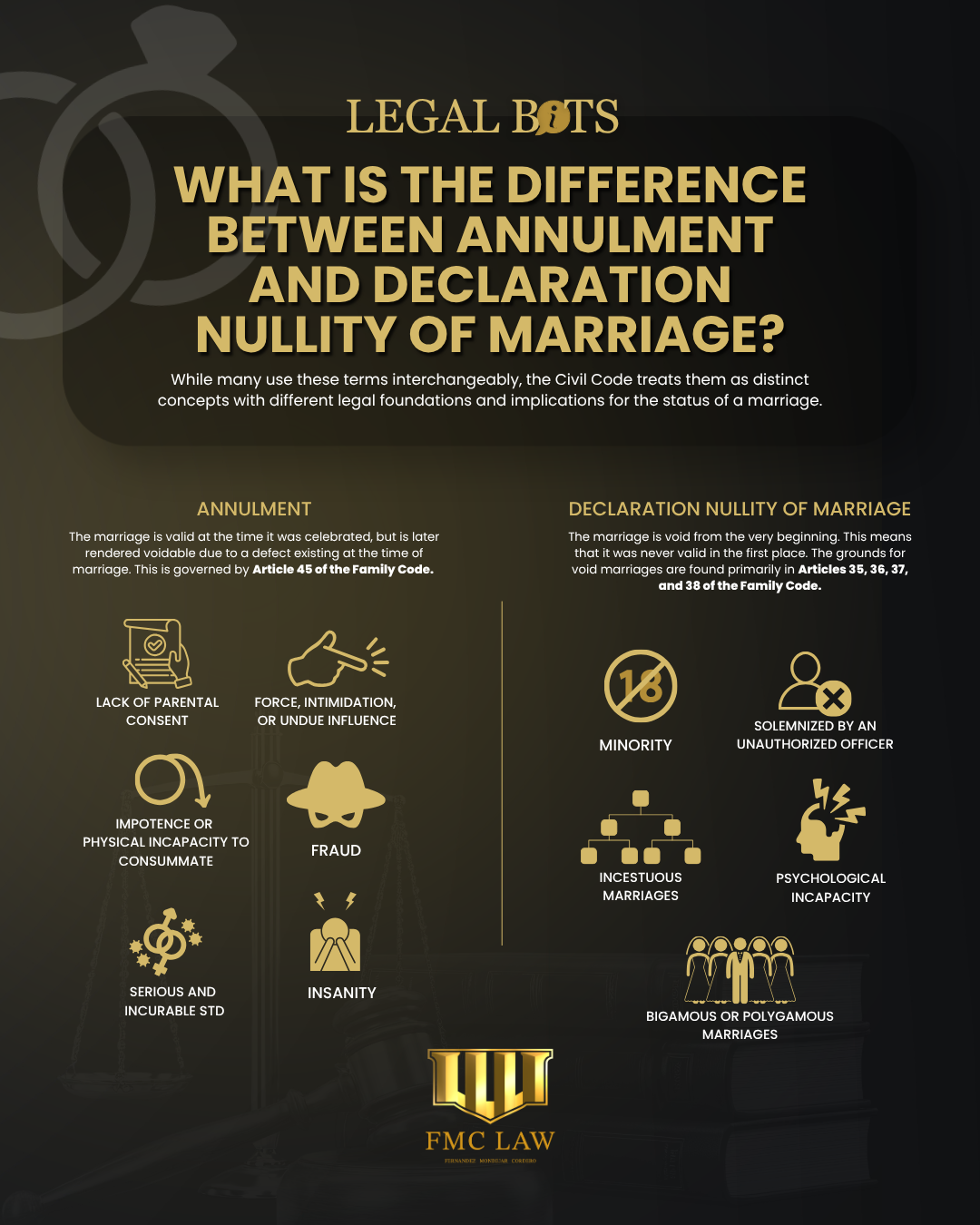
What is a "Voidable" Marriage? (Annulment)
An Annulment applies to a marriage that is considered legally valid until a court sets it aside. These marriages are called "voidable" because they possess all the technical requirements of a wedding, but a certain defect exists that allows one party to ask the court to cancel the bond.
The Grounds for Annulment:
Lack of Parental Consent (Art. 45[1]): If a party was between 18 and 21 and married without parental consent. The petition must be filed within five years of reaching age 21.
Insanity or Unsound Mind (Art. 45[2]): If either party was mentally ill or incapacitated such that they could not understand the nature of marriage.
Fraud (Art. 45[3], Art. 46): This includes the concealment of a prior criminal conviction, pregnancy by another man, a sexually transmissible disease (STD), or drug addiction.
Force, Intimidation, or Undue Influence (Art. 45[4]): If consent was obtained through duress. Continued cohabitation after the force ceases bars the annulment.
Impotence or Physical Incapacity (Art. 45[5]): An incurable inability to consummate the marriage that was unknown to the other party.
Serious and Incurable STD (Art. 45[6]): If a party had a serious, incurable STD existing at the start of the marriage.
Unlike void marriages, some grounds for annulment can be "ratified." For example, if a spouse who was forced into marriage continues to live with the other person after the threat has disappeared, they lose the right to file for annulment.
What is a "Void" Marriage? (Declaration of Nullity)
A Declaration of Nullity is for marriages that the law considers non-existent from the very start. In these cases, you are not asking the court to "break" a marriage; you are asking the court to recognize that a valid marriage never took place.
The Grounds for Nullity:
Minority (Art. 4, Art. 35): If either bride or groom was below 18 years of age at the time of marriage, even with parental consent, the marriage is void. Republic Act No. 11596 explicitly declares child marriages void ab initio. Likewise, a marriage is void if there was no valid marriage license or no authority of a qualified solemnizing officer.
Bigamous or Polygamous Marriages (Art. 35, Art. 41): A subsequent marriage contracted by a person who is still legally married to someone else is void, unless there is a judicial declaration of presumptive death of the absent spouse under Article 41.
Incestuous Marriages (Art. 37, Art. 38): Marriages between close blood relatives (ascendants/descendants and siblings) are incestuous and void. Marriages between step-parents and step-children or those involving parties where one killed the other's spouse are void for reasons of public policy.
Psychological Incapacity (Art. 36): This applies if a spouse was unable to comply with essential marital obligations (love, respect, fidelity, support) at the time of the marriage. In the landmark case of Tan-Andal vs. Andal (G.R. No. 196359, May 11, 2021), the Supreme Court clarified that this is a legal, not a medical, condition. It does not need to be a clinical mental disorder or be incurable. Expert testimony is no longer strictly mandatory; testimonies from family and friends may suffice to establish the behavior.
Solemnized by an Unauthorized Officer (Art. 35, Par. 2): A marriage is void if it was performed by someone who did not have the legal authority to perform marriages, unless either or both of the parties believed in good faith that the officer had the authority.
Because a void marriage "never existed," the right to file a Petition for Declaration of Absolute Nullity does not prescribe. This means it can be filed at any time during the lifetime of the parties.
Annulment vs. Nullity: A Comparative Breakdown
The legal implications of your chosen path affect everything from the status of your children to how your properties are divided.
Feature | Void Marriages (Nullity) | Voidable Marriages (Annulment) |
Basic Status | Considered to have never taken place. | Valid until officially canceled by the court. |
Can it be fixed? | No. It can never be made valid. | Yes. Can be ratified by continued living together. |
Deadline to File | None. The action does not prescribe. | Time-limited. Usually within 5 years. |
Who can file? | Any interested party. | Generally only the spouses or guardians. |
Property Rules | Usually governed by Co-ownership (Art. 147/148). | Usually ACP or CPG (Art. 50). |
Children's Status | Generally illegitimate (except Art. 36/53). | Legitimate if conceived before annulment. |
Procedure: From Filing to Finality
Neither process is "automatic" or based on mutual consent. Even if both spouses agree, they must prove the legal grounds in court.
Where to File: Petitions are filed with the Regional Trial Court (Family Court) where either spouse resides.
Role of the State (Art. 48): Because the State protects marriage, a Public Prosecutor or the Office of the Solicitor General (OSG) will investigate the case for "collusion"—ensuring the parties didn't just fabricate the grounds to get an easy exit.
The Trial: The petitioner must present evidence. In Article 36 cases, the Supreme Court requires "clear and convincing evidence."
Finality: A decision becomes final after 15 days if not appealed. Spouses must obtain a Certificate of Finality and record it with the Civil Registry before they are legally single and free to remarry (Art. 40).
Legal Effects: Children and Property
The law provides safeguards to ensure that the "sins of the parents" do not unfairly penalize the children or lead to unjust financial loss.
Effects on Children
Legitimacy (Art. 54): Generally, children of an annulled marriage remain legitimate. For nullity, children under Article 36 (Psychological Incapacity) and Article 53 also retain their legitimate status per Article 54 of the Family Code.
Custody and Support: The welfare of the child is the "paramount consideration." Mothers usually get custody of children under seven (the "tender-age" presumption). Both parents remain legally obligated to provide financial support.
Effects on Property
Void Marriages (Art. 147, Art. 148): Property is divided based on co-ownership. If both were in good faith, assets acquired through joint effort are split equally. If one party acted in bad faith (e.g., knew about a prior existing marriage), they may forfeit their share.
Annulled Marriages (Art. 50): The marital property regime (Absolute Community or Conjugal Partnership) is liquidated. The "innocent" spouse may be entitled to a more favorable share, and the "guilty" spouse may forfeit certain benefits.
Seeking a New Beginning
Ending a marriage is a technical legal process that requires a precise match between your life story and the provisions of the Family Code. Choosing the wrong petition can lead to years of wasted effort and the eventual dismissal of your case. Because the evidence required for "Psychological Incapacity" is vastly different from the evidence needed for "Fraud," getting the initial diagnosis of your legal situation is the most important step.
Seeking a legal consultation in Iloilo or Manila is the first step toward clarity. Whether you need an Iloilo litigation attorney or an Attorney in Manila, obtaining professional law services ensures that your petition is grounded on the correct legal basis.
If you are ready to explore your options, don't let legal terminology stall your future. Speak with a lawyer to understand which remedy applies to your situation. Contact an Attorney in Manila or an Iloilo litigation attorney today to begin the process of legalizing your new beginning and provide you the guidance needed to resolve your marital status.